
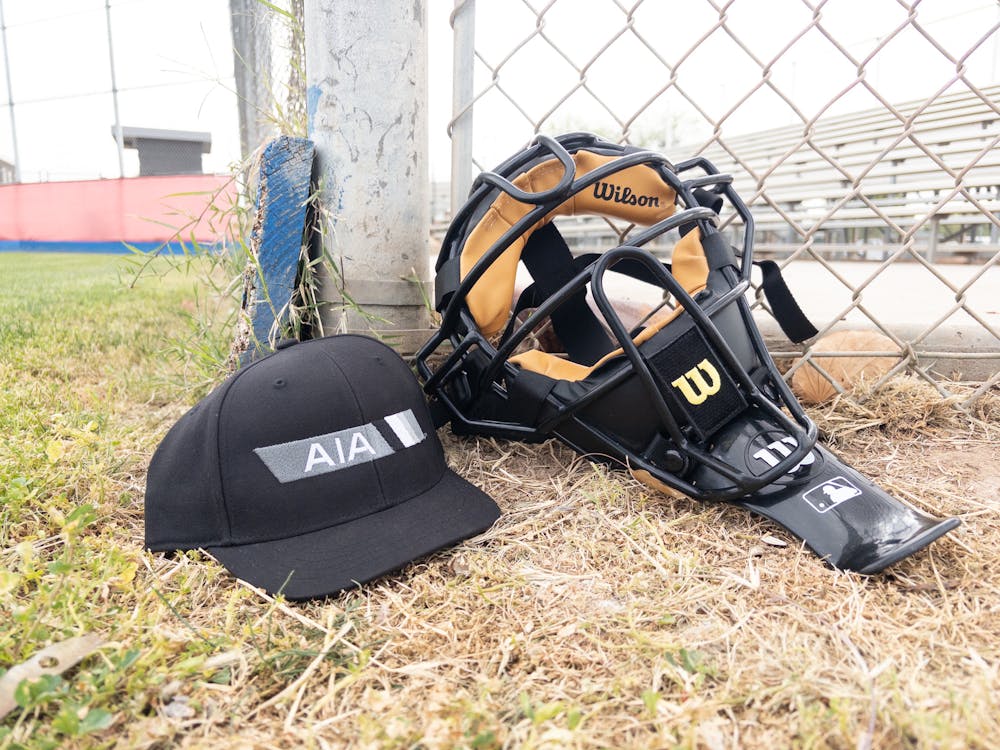
(Photo/Wyatt Baumeyer)
PHOENIX – Fans flock to Seton Catholic Preparatory High School and Omohundro Field on May 6, 2025, in anticipation of a deep 3A playoff run to an 11th state title; meanwhile, Anthony Remedios prepares to call balls and strikes behind home plate.
Only a select group of Arizona Interscholastic Association (AIA) umpires qualify to work the postseason, and Remedios earned the honor to officiate a rematch between the No. 5 Sentinels and No. 12 Apache Junction High School, whom they defeated 11-0 a month ago.
Nonetheless, a nervous atmosphere looms over the stands. In playoff baseball, anything can and will happen.
Despite a tie game entering the fifth inning, Seton Catholic triumphed to a 6-1 victory behind a five-run fifth. Yet, instead of celebration, the day’s most significant drama unfolded off the field.
Approached postgame by an angry fan while walking to the parking lot, the 23-year-old umpire Remedios said he and his partner were verbally assaulted for a call made during the game.
Growing irate by the minute and without a school administrator in sight as required by the AIA, the two called 911 on the fan.
Fearing for his safety while the fan refused to leave, Remedios said a few months later that schools must better anticipate confrontations and protect their officials from poor sportsmanship.
“The administrators at these games need to be aware of what’s going on in that game,” he said. “They should be making sure the officials are safe.”
Remedios’ encounter is not an isolated case, as a growing decline in sportsmanship has dwindled the number of active younger umpires across the United States. With 69% of umpires saying sportsmanship is declining nationally, according to the 2023 National Officiating Survey (NASO), and an aging workforce that pressures the next generation to fill their role, umpires like former professional Zach Richardson said a change in societal behavior is necessary to reverse the trend.
“I don’t want to say society is going to be nicer, but there is gonna be a change in the system,” Richardson said. “They have to be treated better. They have to have a place to grow and become the officials they are meant to be.”
***
Since Remedios started umpiring at age 11, he’s seen an exponential decline in sportsmanship across all levels – defined by Oxford as fair and generous behavior or treatment of others – which he deems the root cause of the shortage of umpires.
“It was bad when I started, but it's gotten just so far out of control now, and it's like that at every level,” Remedios said. “People wonder why there's not enough of us. Well, it's because of the parents and the coaches. That's the number one reason why people don't want to do this anymore.”
With a growing sense of entitlement in society, especially among parents and coaches, Remedios says adults set a poor example for players on the field by encouraging the harassment of officials.
“Entitlement has gotten so far out of control,” Remedios said.
Instead of de-escalating potential crises on the field, Remedios says parents and coaches provoke conflict by repeatedly arguing.
“The kids feed off that energy,” Remedios said. “The kids are going to react to how the coaches and parents are behaving. They are just as much the bad example and kind of that bad role model.”
In contrast, Richardson, age 36, says younger umpires don’t have the mental strength to handle criticism compared to an official with 30 years of experience.
“The younger you are, the harder it is,” Richardson said, adding that age discrimination puts a target on younger umpires. “There's a certain level of respect that comes with being older. It's twofold: the maturity level to handle situations, and then the respect that they are not given from the start, which is a shame.”
As the median age of umpires approached 59 in 2023, per NASO, up from 55 in 2017, Richardson sees a future with more game cancellations.
“People will realize that there will be five years where things get canceled, nothing happens, nothing runs,” Richardson said.
Despite Richardson’s claims of future game postponements, he said current issues persist due to a lack of officials.
High school baseball lost over 20,000 umpires between 2018 and 2022, according to the National Federation of State High School Associations. Similarly, Remedios, who works in administration for California District 52 of Little League Baseball, said he saw a similar decline in the years preceding the COVID-19 Pandemic due to retirements, deaths and a weariness with the criticism they receive.
Remedios said his district boasted a healthy core of volunteer umpires who loved their job and even worked games for free before 2017.
Now, that’s completely changed.
“With the crap that we go through as umpires and officials, and with how much baseball there is, we can't afford to be doing this stuff for free anymore,” Remedios said. “Because of sportsmanship, because of the abuse that officials take every single year, day in and day out.
Yet Remedios said District 52, which operates around the San Francisco Bay Area, targets college-age adults to fill the gap. However, better-paying jobs and a reluctance to confront poor sportsmanship limit their ability to find the right candidates.
“It really depends on the person,” Remedios said. “You got to find the right kind of person. Those that really care about and have a passion in the sport and have that IQ, that kind of knowledge and study of the game.”
***
Across the country from the massive San Francisco Bay Area is the small town of La Porte, Indiana, and Avery Walma, who found a love for officiating after injuries ended any hope of pursuing college athletics.
“I stopped playing football probably at age 11 due to a broken back and then stopped playing hockey because of concussions,” Walma said. “Everything kind of just added up.”
As Walma aged, he began officiating more and more sports to remain in the game.
“At age 12, I started doing football, and ever since, I've continued that path,” Walma said. “After that, it kind of just grew on, the sports added.”
Walma, 20, currently officiates football, hockey and baseball while living between Arizona and Indiana. Regardless of location, he says there aren’t many peers like him due to a lack of proper training.
“You kind of just get thrown in there,” Walma said, adding that former players are reluctant to learn the rules of the game.
“They want to continue to play, or they don't want to get on the other side of it,” Walma said. “They don't want to officiate it. They don't want to dive into a rule book.”
Walma said he sees former players making excuses for not knowing the rules, even though playing offers the best resume for umpiring.
“Playing experience helps,” Walma said. “Having that knowledge of the game helps. You still gotta put your nose in a rule book.”
Despite possessing a strong knowledge of the game, Walma, like Richardson, says his age brings unwanted attention on the field.
“I've definitely seen people try to come at me because of age, compared to like a guy that’s 40,” Walma said.
In moments of crisis, Walma says he stands his ground, as knowledge is a key to winning any argument.
“I stand tall because I know my s—,” Walma said. “I know I know my s—. That’s why I grew up so fast and matured quickly.”
***
What Remedios experienced in the parking lot of Seton Catholic that warm May evening in 2025 wasn’t the first or last time an incident occurred with a fan postgame.
Two years ago, in 2023, Remedios said a player’s family member found his public Instagram account and left a threatening message after a Little League tournament.
“That may be a first that they took the time to go look me up on social media and come into my DMs,” Remedios said at the time.
As technology and social media have grown, Remedios says actions like targeting officials digitally, especially among younger users of these platforms, reinforce an already troubling sportsmanship crisis.
Add video replay at the professional level, and Remedios says it's no secret that umpires are held to unrealistic standards.
“That's set that false expectation, and the fact that people can't accept, ‘Hey, we're humans. We're gonna make mistakes, right?’’’ Remedios said. “Instead of teaching that lesson, people want to point fingers.”
Sports Managing Editor, Blaze Radio