
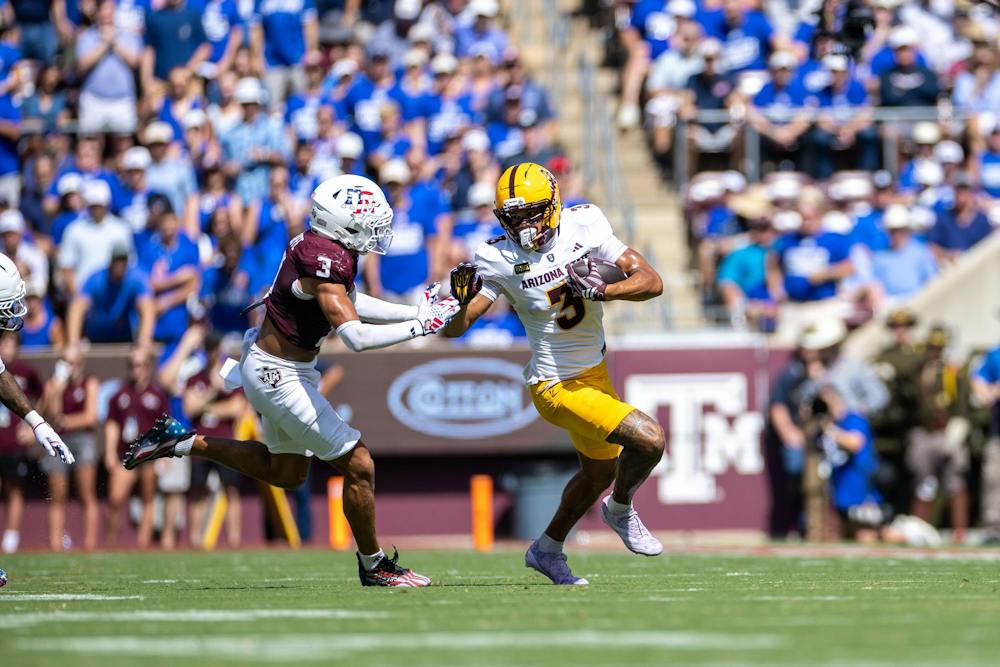
(Photo/Sierra Watson Blaze Radio ASU)
PHOENIX - When thinking of college football’s traditional blue-blood states, places like Texas, Alabama and Florida stand out.
Yet tucked away between the Mountain West and the Great Plains, thousands of miles from college football’s Southern dominance, lies the state of Montana.
Bordering Canada to its north, America’s fourth-largest state by area appears as a remote expanse of land with a cattle population that almost doubles its human population.
Given Montana’s low population density of about eight people per square mile, its omission from the national college football sphere is unsurprising.
Besides a lack of human inhabitants, Montana has no schools at the Football Bowl Subdivision level, and only two compete at the NCAA Division I level: Montana State and the University of Montana.
Even though the Bobcats and Grizzlies are currently premier programs in the NCAA Football Championship Subdivision, the Treasure State lacks representation at the highest level. As of the upcoming 2026 season, only four Montanans are set to play at the Power Four level.
Reed Harris is one of those four.
The junior wide receiver is a native of Great Falls, Montana, and transferred to Arizona State University in January after three years at Boston College.
Knowing college football’s importance to the people of Big Sky Country, Harris carries his state pride across his chest, even if that meant leaving home in pursuit of bigger football aspirations. Now set to play a major role in ASU’s 2026 offense, he still values the opportunity to serve as a football ambassador for Montana at the Power Four level.
“It means a lot to be a representative of the state and to be one of the few people that does it,” Harris said. “It’s really cool to do that.”
Harris arrived in Tempe as the No. 4 receiver in the transfer portal and joins a Sun Devil receiver group that 247Sports named as the nation’s top wide receiver portal class.
ASU wide receivers coach Hines Ward said Harris’ work ethic and 6-foot-5 frame have already made him a great addition to his position group.
“(Harris) is awesome,” Ward said. “He’s been amazing to work with … his size alone, that’s a dominant trait you just can’t teach.”
Now, after a cross-country transfer, Harris said he looks to continue representing Montana as a Sun Devil both on and off the field, even while having a little fun.
Harris knows his Montana trivia. When fellow junior wide receiver Derek Eusebio quizzed Harris on Montana’s state bird, Harris surprised his teammates by instantly providing the correct answer.
Western meadowlark, Harris said.
While western meadowlarks are also found in Arizona during the winter, the Valley of the Sun and Harris’ hometown are as different as it gets.
As opposed to the Phoenix Metro and its sprawling population of nearly five million, Harris grew up on a farm outside of Conrad, Montana, a prairie town in north-central Montana with a population of 2,318.
On the farm, Harris said he found any way possible to spend his time outdoors, including gopher hunting.
“We didn’t have any neighbors, so I would pop the screen out of my window at eight in the morning,” Harris said. “I would get my 22 (rifle), pick off a couple gophers in the backyard and go on with the rest of my day.”
While he enjoyed childhood in the plains, Harris’ athletic aspirations eventually led him away from his hometown.
After spending middle school in Conrad, Harris and his family moved 60 miles south to Great Falls, Montana, before his freshman year of high school.
At Great Falls High School, Harris quickly became a three-sport star in football, basketball and track.
While he pursued football at a high level, Harris’ lone state championship came on the track, running a time of 21.87 seconds to win the 2023 state title in the 200-meter dash.
Harris also shined on the basketball court, helping lead the Bison to their first state championship appearance in 15 years in 2021.
Even while racking up accolades in other sports, Harris’ best work came on the football field.
On the gridiron, Harris did it all for Great Falls, splitting time at quarterback, running back, wide receiver and linebacker.
Harris contributed at every position, racking up 39 career touchdowns, including 21 passing, 13 rushing and five receiving.
Harris said his experience under center at Great Falls helps him and his quarterbacks stay on the same page at ASU.
“I think it helps a lot seeing things from the quarterback’s perspective,” Harris said. “You can kind of see the whole field and how it shapes out, especially when coverages are in play.”
Being versatile on both sides of the ball, Harris became the 2023 No. 1 recruit in Montana and received offers ranging across five FBS conferences, including the ACC and Pac-12.
While local FCS programs Montana and Montana State both offered him a scholarship, Harris said he always wanted to leave home to play under brighter lights.
“I knew I didn’t want to stay in Montana,” Harris said. “I wanted to get out and see the world.”
Set to leave the state he called home, Harris committed to play over 2,000 miles away from home at Boston College under former NFL head coach Bill O’Brien.
Harris became Boston College’s first recruit in program history from Montana.
However, Harris played just four games his freshman year, which led to his redshirting.
Eventually, Harris found his footing as a redshirt freshman and sophomore, compiling over 1,000 yards receiving and nine touchdowns from 2024-25.
Harris credited his breakout to O’Brien’s understanding of the game and his belief in him.
“Coming from (Boston College), Bill O’Brien has probably got some of the best ball knowledge I’ve ever seen,” Harris said. “I got to learn a lot from him.”
Yet a 2-10 season in 2025 led Harris to enter the transfer portal.
Harris ultimately committed to ASU after seeing the recent success of wide receivers, such as Jordyn Tyson, under coach Ward.
Though Harris remained thousands of miles away from Big Sky country, he reestablished existing ties between Montana and Tempe.
Brock Osweiler, a seven-year NFL quarterback and graduate of Flathead High School in Kalispell, Montana, played collegiately at ASU from 2009-11.
As a Sun Devil, Osweiler threw for over 5,000 yards and 33 touchdowns over three seasons before being selected by the Denver Broncos in the second round of the 2012 NFL Draft.
Naturally, it didn’t take long for Harris and Osweiler to connect over their shared experiences, he said.
“He’s a good person,” Harris said. “He’s got a real good personality and it’s fun to talk to him about the Montana roots.”
Now, similar to Osweiler, Harris is poised to be a key contributor to the Sun Devils’ offense in 2026, receiving national attention as ESPN’s No. 31 newcomer entering the 2026 season.
Ward jokingly said he wants to keep Harris’ abilities under wraps until the time comes
“I don’t want to let the cat out of the bag,” Ward said. “He’s got a long way to go, he’s terrible.”
Even with three years in Boston under his belt and a bright future in Arizona, Harris said he is still proud of his Montana background and strives to represent his home state on a national scale.
And just like any native Montanan, Harris said he picks a side every November when Montana and Montana State meet in the Brawl of the Wild.
“I cheer for the Bobcats,” Harris said.