
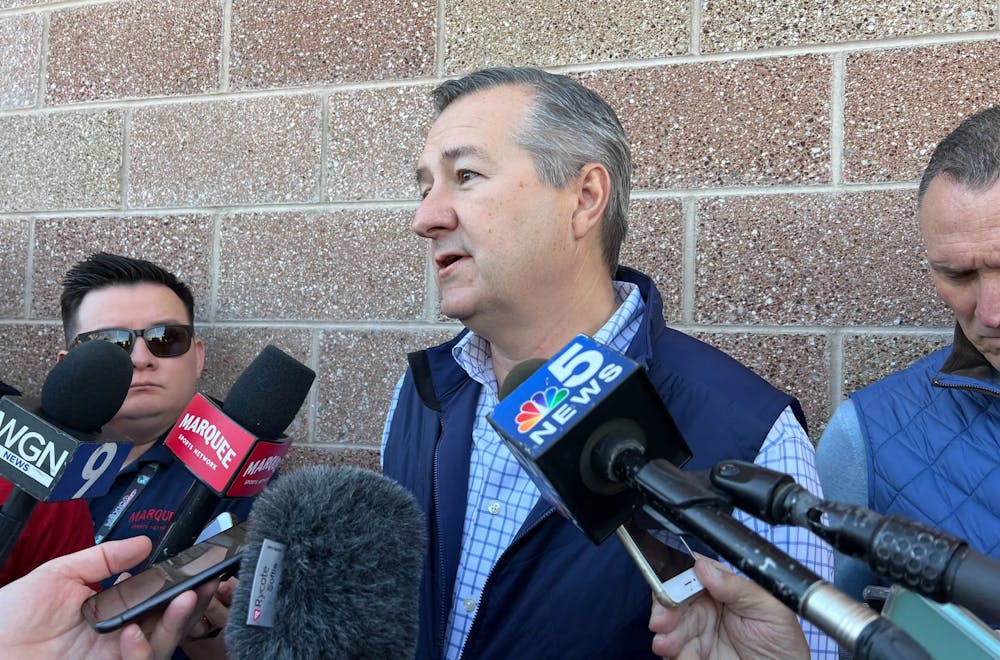
(Photo/Chicago Tribune)
PHOENIX – When Marquee Sports Network debuted at Cubs Convention in January of 2020, fans immediately voiced their concerns to chairman Tom Ricketts.
“What do you have against the Marquee network?” Ricketts said, responding to a sea of boos while on stage at the Sheraton Grand. “Believe me, you won’t be booing about that in a year.’’
Despite Ricketts’ proclamation, fans have continued to boo ever since.
Built on the mom-and-pop days of WGN, Cubs TV ushered in a new era months before the COVID-19 Pandemic, prioritizing business over the fan experience.
Enter 2025, and Marquee just furloughed its general manager and entire digital media staff, raising questions about the team’s finances heading into a crucial 2026 campaign at the corner of Clark and Addison.
Diane Penny, who joined Marquee in 2024 as the GM, lost her job alongside many talented reporters, according to Jeff Agrest of the Chicago Sun-Times. Tony Andracki, content director; Andy Martinez, reporter; and Zoe Grossman were among those let go as well.
Replacing Penny is Cubs chief commercial officer Colin Faulkner, a man with little to no television experience. Faulkner and the team are set to oversee all programming and on-air talent, per Agrest, erasing any line between team and media.
Marquee’s restructuring comes as the network saw a drastic decline in revenue, per the Chicago Tribune, from $90 million in 2021 to $15-to-$20 million today.
With Marquee failing even to generate revenue matching the Cubs’ old partnerships with WGN, NBC Sports Chicago and ABC-7 – around $50-60 million a year per the Chicago Tribune – the question asks itself.
Will Marquee’s struggles affect the Cubs' on-field payroll headed into 2026?
***
Chicago entered 2025 as the fourth-most valuable Major League Baseball franchise at $4.6 billion, per Forbes. Add Sportico’s reported $3.25 million made in revenue per game, and the Cubs are a far cry from being financially strained.
Conversely, Chicago generated $584 million in 2024, per Brooks Gate, up from $506 million in 2023. The Cubs saw a 15% profit in total revenue, yet decreased payroll by 3% over that time frame.
Chicago’s payroll in 2024 was $234,430,623 (10th-MLB), per Spotrac; however, it decreased to $227,017,252 (11th-MLB) the following year, while the team profited by over 15%.
The most telling statistic pertaining to the Cubs' spending comes in revenue generated and put back into payroll. In 2025, the Cubs allocated 36% of total revenue to the on-field team, ranking 26th in MLB, per Brooks Gate. Around $313 million of Chicago’s 2024 earnings did not go toward the luxury tax payroll.
With additional profit coming from sponsorships, such as the Motorola patch worn on the field, valued at upwards of $20 million per Forbes, the Cubs have plenty of revenue streams to capitalize on.
***
Since Ricketts and the Cubs have the resources to spend on prime free agent talent, why aren’t they doing so?
One possible reason lies all around the Cubs’ division, the National League Central.
Chicago’s four divisional opponents (Milwaukee, Cincinnati, Pittsburgh and St. Louis) all operate in the league’s bottom third in payroll and revenue, per Brooks Gate. The Brewers, Reds and Pirates rank 20th, 27th, and 26th, respectively, in franchise value. The Cardinals are the only exception, as they are worth around $2.5 billion or 11th in baseball, per Forbes.
However, all four clubs generated nearly $200 million less revenue than the Cubs, per Brooks Gate.
Milwaukee, the Cubs' thorn in their side since 2018, generated just $334 million in revenue in 2024, per Brooks Gate, and had a $137 million payroll.
Perhaps Ricketts sees the revenue around Chicago and believes his team only needs to outspend slightly to gain the competitive advantage needed to compete.
Another explanation for the Cubs’ lack of spending lies with the looming 2027 lockout in the wake of the league’s new collective bargaining agreement (CBA).
As the CBA is set to expire at midnight EST on Dec. 1, 2026, the game's future economic state remains uncertain. Without clarity on the economics of baseball beyond 2027, owners are reluctant to invest in their teams.
Conversely, a lockout eliminates any, if not all, revenue streams for the 30 franchises.
In a modern era defined by sports teams being run as cooperatives, a lack of revenue severely impacts a team’s ability to spend on the diamond.
***
As the playoff crowd returned to the friendly confines for the first time since 2018, excluding the shortened 2020 season, so have the expectations.
The upcoming 2026 Cubs’ season carries much anticipation on the heels of a 92-win playoff run that fell a game short of the National League Championship Series.
A lineup boasting the starpower of Pete Crow-Armstrong, Michael Busch and Seiya Suzuki carries much excitement; yet, time will tell how the loss of Kyle Tucker affects the offense.
Usually, a large-market team would look to fill the void left by Tucker or simply resign its superstar. Instead, the Cubs operate as a mid-market franchise, looking for good, not great players at the right price.
Sports Managing Editor, Blaze Radio