
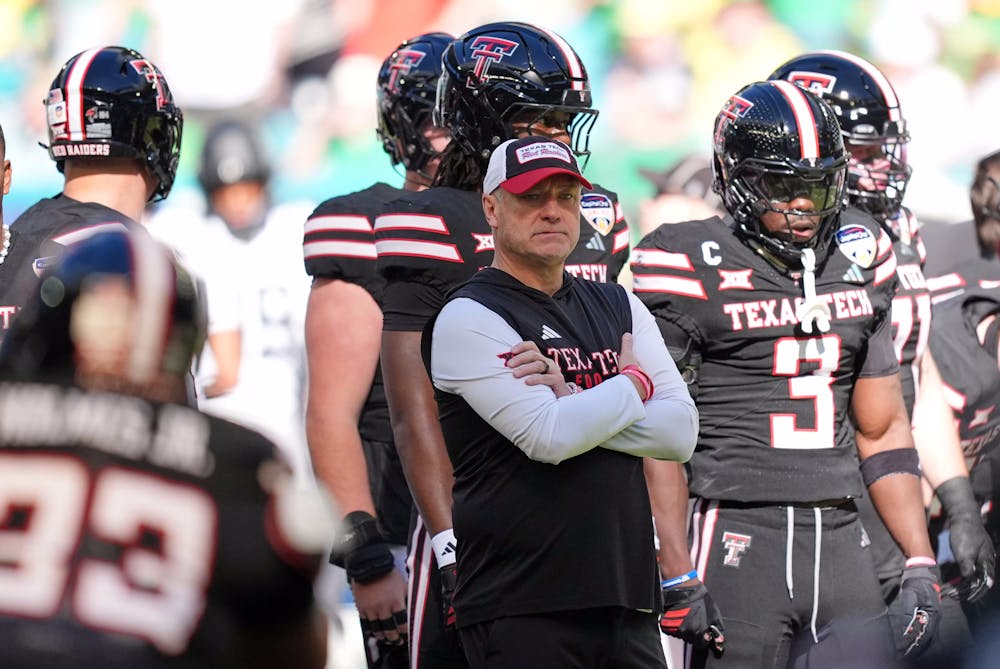
(Photo/Dallas Morning News)
Ninety-six wins and eight losses, equivalent to a 92.3% winning percentage.
That is the combined regular-season record of college football’s top four seeds over the last two seasons.
The new College Football Playoff format, introduced for the 2024-25 season, expanded the tournament to 12 teams and gave those top four seeds a first-round bye.
However, what sounded like a great idea at the time, as a way to give an advantage to the teams that finished with the best record and won their respective conferences, has turned into an absolute nightmare for fans, players and universities alike.
The problem the playoff has run into is that these bye weeks give teams much more time than just one week.
No. 2 Ohio State (12-2), widely regarded as the most talented team in the country, played its last regular season game on Dec. 6th, and did not play again until the CFP Quarterfinal game on New Year’s Eve, Dec. 31st.
For the Buckeyes, the 25 days of rest between games proved to be just too long, as they suffered a historic upset loss to No. 10 Miami (12-2).
While most will chalk the upset up to the “any given Saturday” argument, there is a glaring theme that looms much larger than just with OSU.
Eight CFP Quarterfinal games have been played under the current format, and the teams that are supposed to have an advantage run into a wall almost every time. Teams that received a first-round bye have gone 1-7, equivalent to a 12.5% winning percentage in those games.
The only team to win in these circumstances was this year's No. 1 seed, Indiana (13-1), who knocked off No. 9 Alabama (11-4) in the Rose Bowl.
Even with a statement win, Hoosiers junior quarterback and Heisman Trophy winner Fernando Mendoza spoke about the struggles his team faced after such a long break.
“Especially when you have a bye…” Mendoza said. “It’s tough to get back into the rhythm of football.”
It speaks volumes that the quarterback of the one winning team still commented on the difficulties of a bye week, especially considering their 38-3 victory over Alabama was about as lopsided as it gets.
Yet players aren’t the only ones speaking out on the issues bye weeks are causing, as coaches are just as frustrated with the predicament college football finds itself in.
University of Oregon head coach Dan Lanning has been on both sides of the coin, as his Ducks beat No. 4 Texas Tech (12-2) in a shutout but lost in the Red Raiders' shoes last year to eventual champion No. 8 Ohio State.
“There's clearly a better way,” Lanning said. “I think it really starts with the season moving up… every playoff game should be played every single weekend until you finish the season.”
College football bowl season has been synonymous with the month of December for a long time, and more specifically, New Year’s Eve and day as major slots for the sport.
Lanning’s suggestion would create a schedule unlike anything we’ve ever seen for the college football playoff, underscoring just how serious the problem is becoming for teams that play all season to try to get a top-four seed.
While unprecedented, so is just about every change that the sport could make. Along with Lanning’s idea, proposals such as dropping a week from the schedule, or another change to the number of teams in the playoff.
The general consensus amongst universities and their teams is that the bye weeks just aren’t the issue.
The three-week layoff is.
Drama continues to rage across the college football landscape daily, as NIL and the transfer portal pose obstacles even for the most prestigious schools.
That being the case, the last thing the NCAA can afford is yet another issue that calls into question the fairness of their most popular sport.
Discussions will be had this offseason, but for now, fans can only watch as they wait to crown a new champion.
The four teams left go to battle this weekend, and it remains to be seen if the rust will catch up to Indiana or if it can continue kicking it off.
“You want rest, but you don’t want rust,” University of Texas head coach Steve Sarkisian said. “That balance is hard when you’re sitting for multiple weeks.”