
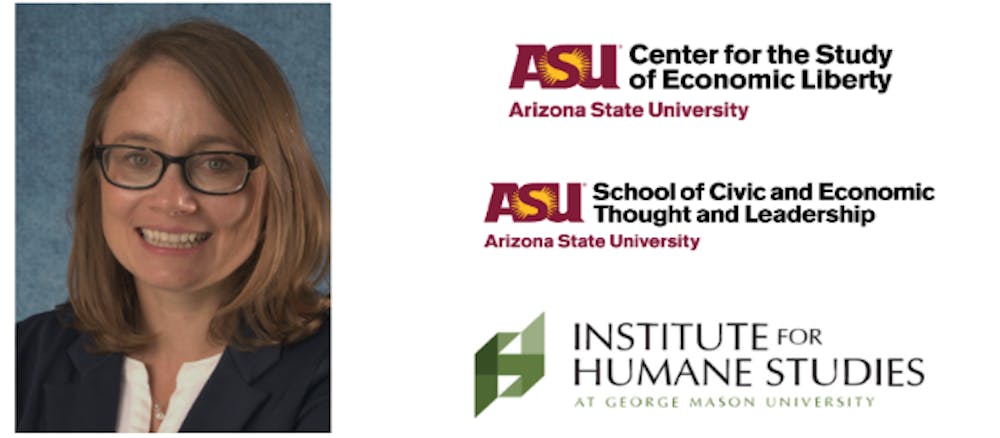
An economics professor at Creighton University said government regulation should be reduced to avoid creating unmanageable rules in her speech on Jan. 29.
Regulations in industries such as beer and car manufacturing tend to accumulate over time, often benefiting concentrated interests while creating unintended consequences, said Dr. Diana Weinert Thomas.
Thomas said that the federal government requires all cars made after 2012 to have backup cameras, which improve safety but add costs and limit consumer choice.
“Regulation over time is cumulative; there is so much regulation that it becomes impossible to keep track of,” Thomas said to a room full of students at Arizona State University’s Memorial Union.
Her speech highlights the broader debate over how regulation affects businesses and consumers and whether lawmakers should simplify the systems in place.
With tariffs on imported goods increasing and the adoption of artificial intelligence expanding, the debate over regulation is gaining more attention.
Beck Laporte, a business student at ASU, said he was surprised by the contrast between past and current regulations, noting that modern rules are more scientific but can also be exploited.
“I’m really interested in seeing regulations of the past compared to regulations now; today it’s much more strategic and that makes it easier for people to take advantage of it,” Laporte said.
Laporte said he agreed with the idea that concentrated beneficiaries often outweigh the broader public's interests.
Another attendee said Thomas’s speech reminded him of challenges he has faced in his career.
Gary Brennan, a Tempe resident with experience in healthcare and business, said companies he ran needed proof and studies to show that regulations worked and independent checks are important to ensure rules do what they should.
Brennan said Thomas’s speech matches his experience running a business, where studies and independent checks were important to make sure regulations worked.
Brennan also shared his view on healthcare, saying, “I’m a strong advocate for Medicare for All; as a country, we’re the only ones in the developed world that can’t figure out universal health care, which I think is a human right, it’s too expensive and our outcomes suck no matter what Congress people tell us.”
Her lecture explored similar themes in other industries, showing how rules meant to help can sometimes backfire.
Thomas said that the “regulatory paradox,” or when rules meant to fix a problem end up making the problem worse, happens when rules start to limit choice and waste more money.
While rearview cameras save lives and cost only about $50 per car, the U.S.’s stricter safety rules make vehicles more expensive than in countries like China, illustrating the tradeoff between safety and cost, she said.
Thomas said that there are two ways to look at rules: one is that government acts ‘romantically’ to help people and the other is that politics is like a market, with lobbying and money moving around.
Small, focused groups that expect large private gains often get more from politics than larger, spread-out groups, she said.
She was citing economist George Stigler’s 1971 theory that regulations are often designed to benefit the market being regulated rather than consumers.
Thomas closed her lecture by emphasizing that lawmakers should carefully weigh the costs and benefits of rules and regulations before enforcing them.
“If lawmakers could take one lesson away, it would be to regulate less,” Thomas said, leaving students with a reminder that regulation should prioritize consumer benefit.
Creighton University Professor Challenges Modern Regulatory System
Similar Posts
- — Final day of the Japanese Film Festival of Arizona, a word on gratitude takes center stage
- — JFoo's movie review: ‘Happyend’ explores surveillance, youth rebellion and a rhythm that hits close to home
- — Japanese Film Festival Opens Fourth Year at ASU Celebrating Cinema and Culture
- — They Sued the Government and Won - Emergency Ruling from Supreme Court Published
- — Recapping the College Ready AZ 2026 Conference