
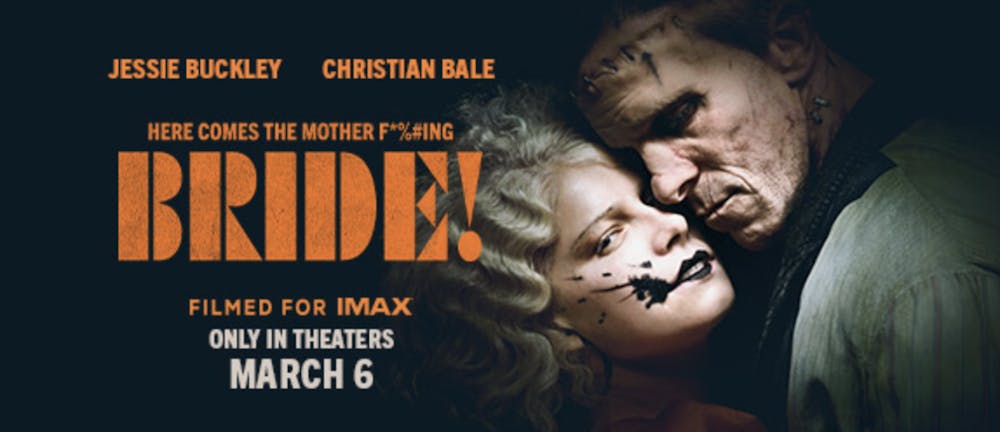
The A-List was given the opportunity to catch an early screening of Warner Brothers “The Bride” a few weeks ago. “The Bride” is a Gothic romance film directed and written by Maggie Gyllenhaal and stars Jessie Buckley as the titular Bride and Christian Bale as Frankenstein. The film is a modern feminist retelling of the classic “Bride of Frankenstein” story. In 1935 New York, scientist Dr. Euphronious brings a murdered young woman back to life to be a companion for Frankenstein's monster, but the journey the two “monsters” experience is anything but typical.
While we definitely have some strong feelings on the film, we always encourage readers to watch the films themselves to form their own opinions, so please don’t take our opinions as absolute. We’re just some college kids who have strong opinions and love a good movie. As always, a big thanks to Allied Global Marketing for the opportunity to cover the film. With all that context out of the way, let’s talk about “The Bride”!
Larisa: We’re entering a new, nuanced era of movie monsters and Maggie Gyllenhaal’s “The Bride!” fell short of my expectations. Instead of feeling like a hard-hitting feminist flick, it felt more as though the film had too much to say but wasn’t willing to die on the hill it spent its two-hour-six-minute runtime climbing.
With a star-studded cast featuring Jessie Buckley, Christian Bale, Jake Gyllenhaal and Penelope Cruz, my expectations were a bit high going in. Buckley plays a dual role as both the titular Bride and author Mary Shelley, who, for the duration of the film, is trapped in a black-and-white hellscape. Bale portrays Frankenstein, Gyllenhaal is silver screen actor Ronnie Reed and Cruz plays the chain-smoking detective Malloy.
The film takes place in 1930s Chicago, and starts with Shelley in her black-and-white prison, explaining to the audience that the story of Frankenstein wasn’t over yet, and that she was going to find a way to tell the rest of it. She then “possesses” Ida, who is then murdered by the mob for trying to speak out. We then see Frankenstein, or “Frank,” as he’s called, go to a mad scientist in Chicago, asking her to make him a companion. They use Ida’s body, and when she comes back to life as “The Bride,” she has no memory of who she is and the story ensues from there.
A key theme of the movie is consent and women’s control over their bodies, but in my opinion, it does a terrible job at portraying it. Ida is sexually assaulted on screen multiple times throughout the film, but the way it's shot feels more sexualizing than invasive. To add insult to injury, Shelly is in her head the whole time screaming for her to “stand up for herself” and “fight back” but every time she’s instead rescued by Frank. The one time she does stand up for herself, she’s immediately filled with shame and spirals out.
Ida is manipulated and abused by almost everyone she encounters, including Frank and Dr. Euphronious. The film takes issue with almost every man it features, but instead of fully leaning into its messaging, it tries to redeem multiple characters who took advantage of Ida. The movie’s plot devolves from the main idea almost a half hour in, and from that point on it seems as though it has no idea what it’s trying to say. Add in the plot of Frank and Ida trying to expose mafia secrets to the public, all while Ida doesn’t know who she is, Mary Shelly is in her head and detectives are trying to hunt them down, and you’ve got a recipe for a mess of a movie.
The script may have been the worst part. It’s clunky and corny, and feels muddled throughout. Very few scenes actually have dialogue that feels even remotely natural, and when there are finally moments of clarity, Ida becomes “possessed” again, going on a rhyming ramble, because, of course, if an author were taking control of someone from beyond the grave, she would just start listing words she knew.
I think my main issue is that the potential was there. A simplified plotline and more coherent messaging could have saved this film from itself. A movie about The Bride getting her revenge on her creators and standing up for herself could be great, but it gets bogged down with unnecessary characters and plot points. I think the actors did the best with what they were given, but even an Oscar-winner like Buckley couldn’t save this colossal flop.
Gib: Did anyone see the second Joker movie? I think it was called “Joker 2: Electric Boogaloo.” Whatever. That part doesn’t matter. What matters is that I didn’t watch it because I heard it was terrible and a mockery of the first film. Thankfully though, I got to experience the joy of watching the second Joker movie without ever having to pay to watch it, because I saw Maggie Gyllenhaal’s “The Bride!” for free!
I mean this in the way that a lot of the criticisms I saw for that are similar to the issues with this film. The plot is muddled, the character motivations are unclear, the chemistry between the leads is nonexistent and there are some really weird and misplaced musical sequences.
The script here is incredibly clunky. Every piece of dialogue feels strung together by tissues and it sometimes feels as though our titular leads Jessie Buckley and Christian Bale are having conversations with two completely different people. This is very much an issue when the entire story is meant to be centered around their love for each other and that is one of the many undeveloped points.
There are no real moments that showcase how their feelings for each other develop at all besides a few montages of them running around and laughing. The audience is just meant to believe they love each other because Mary Shelley at the beginning of the film is screaming at the audience that this is “a love story, or maybe a horror!”
I was also confused as to what universe this took place in and Shelley’s role in it all. Shelley was always present in the film, sometimes popping in from whatever black and white hellscape she was trapped in to say some nonsense and possess Buckley. So was this then implying that this was in a universe where Shelley did write the book, and it was fake, but then Frankenstein happened to exist?
Did Shelley meet Frankenstein personally? Is this the same universe as the one Shelley wrote, so she was never involved and the events of Frankenstein occurred and everyone knew them, and this is just what happened after? Because it seems as though the other characters are familiar with Frankenstein, so was this just a scientific discovery? Is Mary Shelley the God of this universe? I DON’T UNDERSTAND.
I don’t think anyone in the writer’s room understood it either. No one seemed to understand that the most interesting scene in the entire film occurs more or so halfway through, and it’s actually between Christian Bale and Jake Gyllenhaal's character. This moment is fantastic honestly, and showcases the inherent tragedy that Frankenstein is about, which is the curse of being alive but ultimately never being accepted and always being alone. I hate to say that the best part of the whole thing was an interaction between two male characters, when it is obviously supposed to be a statement on women’s place in the horror genre and changing the narrative around what horror can be, BUT COME ON.
I don’t really think the movie cared that much about that statement either, as one of the perpetrators of the constant violations that Buckley’s character has to endure is eventually redeemed, even though it could be inferred that he was one of the worst of them all. This man was a cop and sexually violated our female lead, and then he was redeemed. This film is still too cowardly to take any stance on the fact that the police system is perpetrating this violence against women, and then any of the actual men who speak to Buckley in person rather than operate from the sidelines are all redeemed.
There was also this weird 5 minutes where everyone starts dancing in a giant musical sequence. Were they possessed by Mary Shelley? Why does no one care? Why is no one screaming afterwards that they were just possessed to dance with people they think are about to kill them all?
I don’t know. I don’t think I will ever know.
This film is going to haunt me for the rest of my life. It’s one of the only things I have ever watched in a theater that I seriously questioned walking out of, and if I wasn’t required to write this article about it, I would have. So everyone is required to read this and be haunted by Jessie Buckley/Mary Shelley speaking to them in tongues for the rest of their life like I will be.
Spencer: I think you can tell from Larisa and Gib’s reviews that we did not enjoy the movie very much, and I am in the same boat as them. Oftentimes, I’ll watch a new release in theaters, I’ll have mixed opinions, and move on with my life. Most movies are just fine, and that’s fine, because not every movie can be amazing. That’s just not how art works. But “The Bride” was something so much worse than fine, worse than bad; it was genuinely boring. A slog of a film, you could say. And the worst part is, I had to sit through over two hours of this boring, corny attempt at filmmaking.
One part of the film that really got under my skin was the Mary Shelly character. I almost always take issue with a writer using a real person as a character in a movie, especially when they are making a new character out of that real person. No, this is not what Mary Shelly was like. No, she was not forced to write “Frankenstein” on a dare. And no, she is not living in this black-and-white limbo waiting to possess some woman in the 1930s. This presentation of Shelly was offensive, sure, but it was also just cringeworthy. She shouts a bunch, yells at The Bride to “Rise!” “Fight!”, she could have been selling peanuts for all I cared. She was saying nothing of substance, contributed nothing to the actual plot of the film, and was basically used as Gyllenhaal's personal monologue so she could say, “Hey audience, look! See how angry she is? She is the inner anger all us women feel, huh guys?” But ultimately, the character doesn’t present anything of worth and says nothing about women’s place in society; she simply comes off as this annoying, millennial rage, Jiminy Cricket type, that would have been better off in a Dan Hentschel meme than in a feature-length film.
Some other characters I felt were useless and contributed nothing to the film: Peter Sarsgaard as Police Detective Jake Wiles (Some random cop that has a weak connection to the Bride and provides nothing to the story itself), his assistant/fellow detective Myrna Malloy, played by Penélope Cruz (who is forced down our throats as this “strong woman in a man dominated field” despite being completely useless as a detective), John Magaro as Clyde, this random dude who works for a mob boss and is tasked to kill The Bride (despite the fact that he shows up once every 20 minutes, does nothing, and has no substantial impact until the last 3 minutes of the film) and Zlatko Burić as Lupino, a Chicago crime boss (who is the most generic evil dude ever put to screen, a man who literally kills women and puts their tongues in jars. How much more cliché could we get?) All these characters come off as if a high school student wrote them. They are one-note, boring, screenwriting 101 characters, and ultimately provide nothing to the movie. If the plotlines with all those characters were dropped, the movie would not miss a single beat – and the audience would be spared 20 minutes of their lives.
The story itself dragged on forever and was all over the place. It couldn’t decide whether to be a triumphant story of a woman taking back her autonomy and freedom, or the story of a woman who is forever stuck in a world that will never respect her and will always put her down. It can’t be both ways, yet the audience is expected to accept both narratives. Is she both a revolutionary and a cog in the machine? PICK A SIDE! It just feels like Gyllenhaal had an idea in her head of what she wanted the themes of the film to be, and then had no idea how to actually execute them, so she just threw it at the wall and hoped something stuck. Well let me tell you, none of it stuck. “The Bride” is currently sitting in a sloppy mess on the floor, waiting to be picked up by an audience of moviegoers who could watch paint dry and say, “This is deep.”
I can appreciate the fact that there was a clear attempt at originality. Gyllenhaal was trying to say something of importance, and the ideas behind the film have some sort of legs. But the execution was just so poorly done, so egregiously self-aggrandising, that it becomes something I can’t bear to even think about. You can tell Gyllenhaal thinks she is saying something so profound, it’s so much like “Joker” in that way. I really despise when filmmakers think their movies are changing the world, or that the message they’re putting on screen is something so worthy of praise. That is for the audience to decide, not for the movie itself to decide.
I don’t really understand how Warner Brothers looked at this script and said, “Give her $100 million and full creative freedom.” It makes me angry how much this film cost, because five fantastic movies could have been made with that one singular budget. Yet here we are, stuck with “The Bride,” forever to be remembered in our cultural zeitgeist as another gothic horror romance film that will only appeal to the Hot Topic crowd, and will leave nothing of note for the rest of the world.
I suppose it doesn’t help that this came out just months after Guillermo del Toro's masterpiece “Frankenstein,” because it’s unfair to be associated with such an amazing piece of cinema. Yet, “The Bride” will forever be looked at through that lens, as a movie attempting to ride off the coattails of “Frankenstein.” Hey, it’s sort of like what happens in the actual movie! How funny can reality be sometimes, huh? Go watch “Frankenstein,” and don’t waste your time on this offensively dreadful two-hour snoozefest. Thanks!