
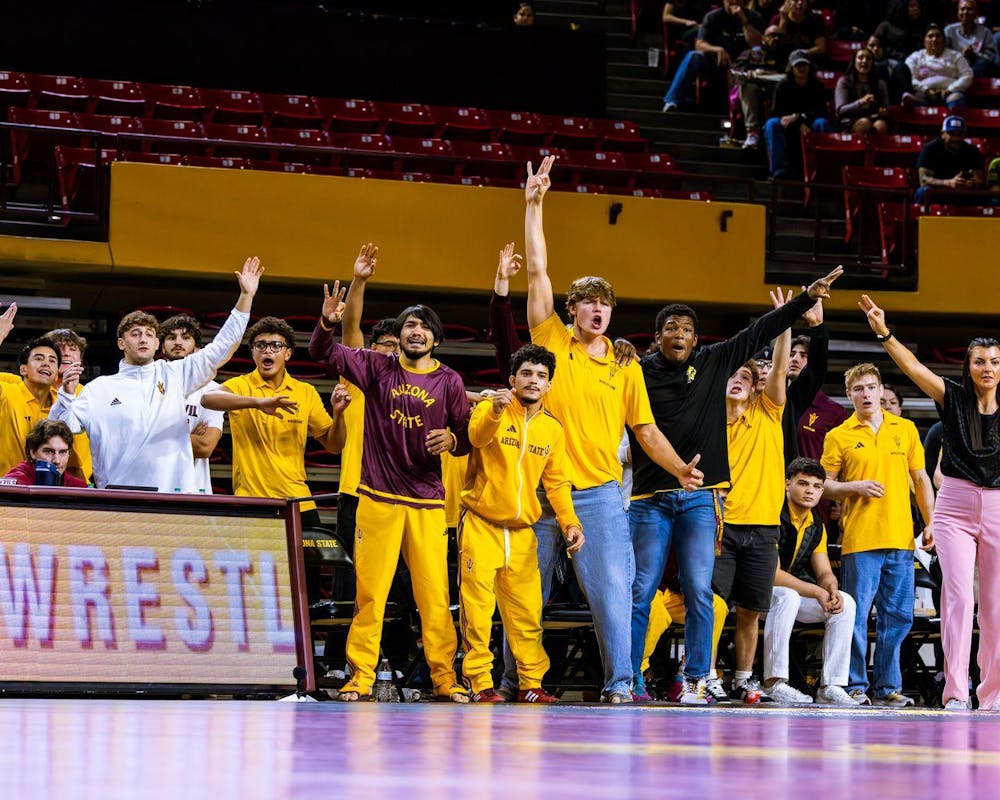
(Photo/Andrew Han Blaze Radio ASU)
PHOENIX — Brotherhood is a word often used in sports.
Teams claim it. Programs promote it.
However, inside the Arizona State wrestling room, brotherhood is not a slogan; it is a standard.
For graduate student heavyweight David Szuba, he says brotherhood begins with trust.
“Brotherhood means guys you can lean on,” David said. “Guys you can be vulnerable around, but also guys who can give you a hard time.”
That balance of support without softness and ego defines the culture at ASU.
Wrestling is an individual sport once the whistle blows, but there is nothing individual about the work leading up to the competition.
Freshman heavyweight Ben Szuba said bond is most visible in moments away from the mat.
“Guys you work close together with,” Ben said, “Guys you can call at 3 a.m.. They’ll be there for you. Our team is pretty close in that aspect.”
That closeness is a change from previous teams he has been part of.
“On my high school team, there were groups,” Ben said. “Not everybody got along.”
As a Sun Devil, Ben said those divisions do not exist.
“With this team, everybody hangs out,” Ben said. “Everybody has a good time with everybody.”
That sense of freedom, to be fully yourself without fear of judgment, is what brotherhood means to sophomore 149-pounder Kaleb Larkin.
“Freedom to be yourself without any judgment,” Kaleb said.
Inside the wrestling room, personalities do not have to be muted. Teammates joke, compete, argue and move on.
Kaleb said he sees that dynamic most clearly in his relationship with his brother, freshman 133-pounder Kyler Larkin.
“We can almost fight each other,” Kaleb said, “and then just be chill after. No hard feelings.”
That ability to confront one another honestly without resentment mirrors the larger team culture. Accountability does not fracture relationships at ASU; it strengthens them.
For the Larkin brothers, brotherhood also stretches beyond the current roster. Their father, Eric Larkin, a former Sun Devil wrestler, created a legacy that still resonates with alumni and fans.
“The older fans are always coming up, (saying) ‘Big fan of you, your dad was amazing,’” Kaleb said.
Kyler said he feels that everlasting connection as well.
“There are so many guys who were on the team with our dad who still show up to meets,” Kyler said. “They talk to us like we’ve known them for 30 years.”
Brotherhood at ASU does not end at graduation; It carries forward across generations.
That idea of legacy is also central to freshman 197-pounder Aidan and senior 141-pounder Emilio Ysaguirre, whose relationship as brothers mirrors the program's culture.
“We just see each other the same,” Aidan said. “We talk trash, joke around, and nobody gets too sensitive.”
That dynamic reflects how they grew up.
“With my actual brother, we joked around and had fun,” Aidan said. “But we also knew we had each other’s backs.”
To the Ysaguirre brothers, brotherhood is built on trust and respect.
“It sets a legacy,” Aidan said. “Brotherhood is being able to trust each other and respect each other.”
Wrestling together has also taught them responsibility.
“One of the biggest things is being responsible,” Aidan said. “Knowing when you mess up and owning up to it.”
That responsibility extends to academics and training.
“Not cutting corners,” Aidan said. “Going 100%.”
Emilio shared that work ethic sentiment.
“Accountability is big,” Emilio said. “Holding each other accountable, good or bad, while still having love for each other.”
The brotherhood also extends beyond the wrestling room.
“We have so many alumni,” Emilio said. “They see our ASU wrestling gear, and it just runs deep.”
Fans recognize them, too.
“We see little kids who are brothers,” Emilio said, “and they want to be where we are, wrestling together.”
From the coaching staff’s perspective, brotherhood is a cornerstone of the program’s identity.
“The three values of the team are grit, gratitude and brotherhood,” head coach Zeke Jones said. “Grit and gratitude are individual behaviors, but brotherhood connects us.”
Jones said brotherhood remains constant regardless of results.
“Whether they’re winning or losing, they’re locking arms,” Jones said. “They know it’s bigger than themselves, it’s their teammates.”
He compared the sport’s intensity to something deeper.
“Sports can be symbolized like war,” Jones said. “You’re in combat with someone next to you who loves what you love and is willing to lay it on the line for you.”
Jones said younger wrestlers are still learning what brotherhood means, while older athletes understand it more fully.
“They’ve been down the path,” Jones said.
To Jones, the presence of multiple sets of brothers captures the program’s culture.
“The three sets of brothers symbolize what we’re about,” Jones said.
Likewise, David said brotherhood remains what sets Sun Devil wrestling apart.
“A lot of people claim to be family,” David said. “But brotherhood is different.”
Family is broad. Brotherhood is tighter.
“A little closer,” David Szuba said.
Ben hopes people associate ASU wrestling with one additional trait.
“Hard workers,” Ben said.
In Tempe, brotherhood is not something wrestlers talk about; it is something they live. It means answering the phone at 3 a.m., holding teammates accountable and standing shoulder to shoulder through every high and low.
“Brotherhood here isn’t just a word, it’s a lifestyle,” David said. “You know your teammates have your back no matter what, and that makes everything else possible.”