
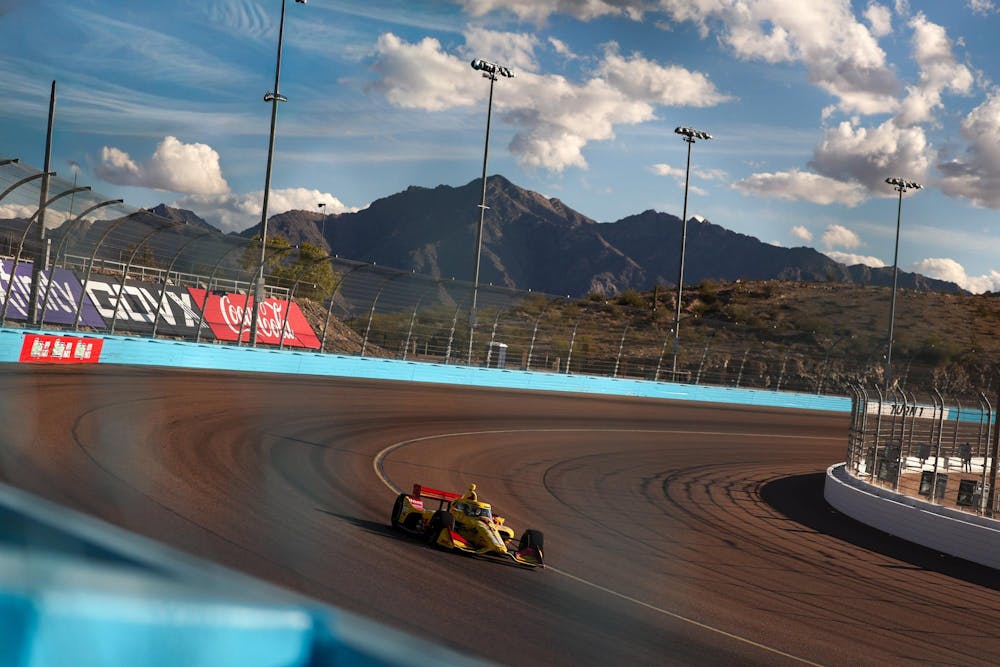
AVONDALE, Ariz. – Racetracks weren’t built to sit silently. These colosseums reverberate with the echoing of engines and hum of horsepower during race weekends. A sharp scent of gasoline and tire rubber hangs heavy in the air, casting the spell of speed and science over spectators.
Its source, Phoenix Raceway, was a staple of open-wheel racing and hosted NASCAR since 1977. But open-wheel racing abandoned its fans in 2005. CART, the sanctioning body, dropped the track from its schedule amid instability, leaving the speedway with only two major dates.
After 20 years of inconsistency, the NTT IndyCar Series is set to return on Saturday, March 7.
“It's like we're welcoming them back home,” Phoenix Raceway President Latasha Causey said.
Phoenix hosts the first-ever oval doubleheader between IndyCar and NASCAR. Homecoming for IndyCar is set for Saturday, and NASCAR competition begins on Sunday, March. 8.
“We have also seen that our fans appreciate it by our ticket sales as well,” Causey said, expecting a grandstand filled with fans. “We know that Saturday is going to be a really great day.”
As of 2026, the open-wheel product appears unrecognizable. The track changed. The teams changed. The cars changed. Even so, the spirit of open-wheel racing in Arizona endured.
A historical oddity
Phoenix became known for attracting the premier stock car series, but it wasn’t the first to race in Arizona. That started with open-wheel racing, specifically the United States Auto Club (USAC).
“The history actually goes back like 1905,” journalist David Land said. “There's been this kind of racing out West, especially in Arizona, since then; they didn't really have a central hub until Phoenix Raceway.”
First constructed in 1963, the Phoenix International Raceway opened with hopes of becoming the “Indianapolis of the West” by attracting USAC competition. A year later, four-time Indy 500 winner A.J. Foyt hoisted the first trophy at PIR, defeating Roger McCluskey and Parnelli Jones.
“For years and years, IndyCar racing was the big event at Phoenix Raceway,” Land said. “So it's kind of been odd, actually a historical oddity, these last couple of decades where IndyCar hasn't been a consistent presence in Arizona.”
In 1982, USAC racing transferred series control to the Championship Auto Racing Teams (CART), and Gordon Johncock won the series' first event at the track.
According to Land, Phoenix Raceway became “a staple of the CART series from ‘79 to ‘95.”
Then, with the sanctioning body's help, Phoenix helped bring the sport into the modern era.
Open-wheel racing suffered a major blow to unity in 1996 when CART and Tony George’s new Indy Racing League (IRL) battled for control of the fanbase. Drivers, teams and fans were forced to side with either series, wounding attendance and TV viewership.
“When the crowd showed up at Phoenix in ‘96, and it looks the same, it sounds the same, but the driver's names are different,” Land said. “There just weren't the big names that people expected to see, and people had become accustomed to.
“And the racing changed quite a bit.”
Meanwhile, Phoenix Raceway began hosting the NASCAR Cup Series in 1988 with Alan Kulwicki claiming his first of five victories that November. The track even boasted IMSA GT competition, utilizing an 11-turn infield road course for the championships from 1992 to 1995.
“People who previously showed up for Michael Andretti and Al Unser Jr. now showed up for Jeff Gordon, Dale Earnhardt,” Land said. “And those guys are still showing up.”
As for the IRL, George tabbed Phoenix to host the second of three events in 1996, and it held this slot on the schedule until 2005. Low attendance, paired with NASCAR's meteoric rise in the early 2000s, ended open-wheel racing’s 41-year tenure in the Grand Canyon State.
“Unfortunately, Phoenix was kind of an innocent bystander in the political war,” Land said.
CART filed for bankruptcy in 2003 and transformed into the Champ Car World Series, but collapsed due to a lack of sponsorship. The IRL, now IndyCar, absorbed the remains of Champ Car and reunified open-wheel racing once more.
“There wasn't a compelling reason to get behind IndyCar racing from ‘96 to 2005,” Land said.
“A huge problem with it is that the sport lacked so much stability that people were turned off.”
Then, as NASCAR's notoriety grew, the facility evolved to accommodate changing needs. The road course was scrapped, and the track was reconfigured with variable banking in 2011.
“The previous configuration of Phoenix was more suited to Indy car racing,” Land said. “But I think that the 2018 race was pretty promising, and since 2018, IndyCar figured out how to get passing a little bit easier at short ovals.”
Healing old wounds
Phoenix and the West Coast racing scene suffered from the split, with the series continuing to repair the damage. IndyCar removed tracks like Las Vegas Motor Speedway from the calendar, while locations such as Auto Club closed. The sport needs to rebuild a national championship by engaging with new fans.
Tiffany Rodriguez, 18, and Austin Rodriguez, 13, are siblings from Buckeye, Arizona, who fit what IndyCar chases. The two grew up around the Supercross world, but only recently started watching IndyCar. They visited Phoenix Raceway during the February Unser IndyCar Open Test.
“I really like that they're like us, you know,” Austin said of the modern stars. “They have more things they could do, but they're just like us. So it feels like we could connect it to them more.”
Austin encourages others to chase the adrenaline that comes with open-wheel racing.
“If people don't see or feel thrill in their normal day-to-day life,” Austin said. “They can experience it on TV or whatever they’re using.”
The former has attended a NASCAR race and enjoys watching F1, but her heart lies with IndyCar.
“I thought that IndyCar is way better than NASCAR,” Tiffany said. “It's a once-in-a-lifetime experience.”
Tiffany encouraged seeing the sport with one's own eyes, and it could “really make you get into it.”
One of the drivers that got her into IndyCar was Arrow McLaren driver No. 5 Pato O’Ward.
“IndyCar oval racing really is obviously part of what the fans love,” O’Ward said. “I think I share the same passion as a lot of the other guys in terms of racing.”
O’Ward doesn’t know what to expect in terms of racing and described the track as almost new.
That’s due to only five active drivers with previous experience in Phoenix: Will Power, Josef Newgarden, Alexander Rossi, Graham Rahal and Scott Dixon.
The latest crop of IndyCar talent is eager to tackle the challenge in front of a varied audience.
“I think it's great that hopefully we get new fans engaged,” four-time IndyCar Champion Alex Palou said. The Chip Ganassi Racing driver believes new fans are in for a surprise.
“I think a lot of people don't realize the speed that INDYCARs have,” Palou said.
Seventy-three-year-old Ronald Spannraft agreed with Palou’s assessment.
“The speed, the agility, the handling of those cars,” Spannraft said, is captivating.
The Maricopa native travels the U.S. to collect hats from various tracks, converting them into jacket patches. Spannraft carries 49 patches, but lost count of the various racetracks he visited.
“There was a track near the base road course, and my brother had convinced my dad to take him, and I tagged along,” Spannraft said regarding his introduction to racing. “I was hooked.”
Spannraft grinned when he thought about what makes the sport so special and said, “The speed, the agility, the handling of those cars."
Once you catch the bug, he encourages fans to go further than Phoenix. “If you really want to enjoy them, though, go to a road course track like Laguna Seca, Road America, Mid-Ohio. You're really going to find some tremendous racing on those facilities,” Spannraft said.
Land hopes that this stop in Phoenix is not a one-and-done deal.
“I hope that this is a staple of the calendar, because I think that there's real potential to grow this as an event,” Land said. “And then, once we get the West Coast going, let's get the East Coast going, and then we'll finally have a true national championship again.”