
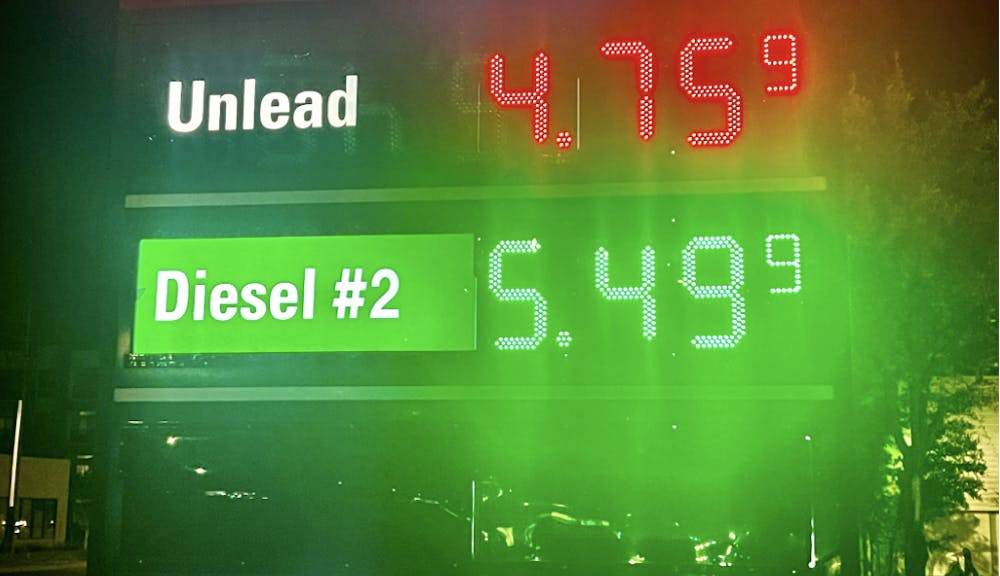
PHOENIX — Arizona State University students are experiencing financial strain due to rising crude oil prices amid the ongoing war with Iran.
Students are starting to feel the financial impact of higher prices, and many are spending more on gas and tightening their already stretched budgets.
“I’m definitely not happy about recent gas prices,” said Karol Juarez, a student at ASU. “It just makes commuting a lot more inconvenient.”
Juarez said that she drives to campus every day, with her drive taking approximately 20 minutes.
"I've definitely been budgeting, and I've been fine, but the increase in gas prices has definitely crept into my savings account," Juarez said. "I carpool a whole lot with my family when I can to save money."
The rising price of gas is impacting all ASU students; however, with multiple campuses, it is particularly difficult for many students.
“Surveys suggest that two-thirds of students at ASU have cars, but the amount of driving they do may vary," Hoffman, an economics professor at ASU, said. “Those who would be hurt the most are students who commute long distances to attend classes.”
Many students are turning to public transportation, specifically the school shuttle, to get to school. However, some students believe it isn’t enough.
C-era Walker, a student who attends the West Valley campus, said the university needs to do more to incentivize students into using public transportation.
“When it heats up, it’s unrealistic to expect students to use them,” Walker said. “We need more shade, seating and sprinklers near hot spots around the shuttles. This would make students more comfortable ditching the car during times like this.”
On the bright side, Hoffman believes that the price of public transportation will likely not be affected by the rise in gas prices — a positive for public transportation users.
For Juarez, public transportation isn't the alternative she's looking for. "I've taken the city bus to campus twice this past semester, and it just feels uncomfortable and slightly dangerous," Juarez said. "I prefer to drive, despite recent gas prices."
It’s not just the price of gas that students need to worry about. “Gas and diesel price increases will show up in groceries and in the cost of delivery,” Hoffman said.
The U.S. Department of Agriculture predicts food prices will rise by 3.6% by the end of 2026 due to higher diesel prices. Diesel is widely used as a raw ingredient in synthetic fertilizers, which means the prices of fruits, vegetables and cereals will increase as fertilizer prices rise.
Synthetic fertilizers are a critical input for large-scale agriculture, with more than 3 billion people relying on them to grow their food.
The controversial American-Israeli war with Iran, which started on February 28, led to crude oil futures rising by more than 68% at their height, going from $67.02 the day prior to the start of the war to $112.41 at their peak on Wednesday.
With the announcement of a two-week ceasefire on Tuesday, crude oil futures fell to $75.18, marking one of the largest price declines since the conflict began. However, the price quickly rebounded the following day, and as of Wednesday it stood at $91.07.