
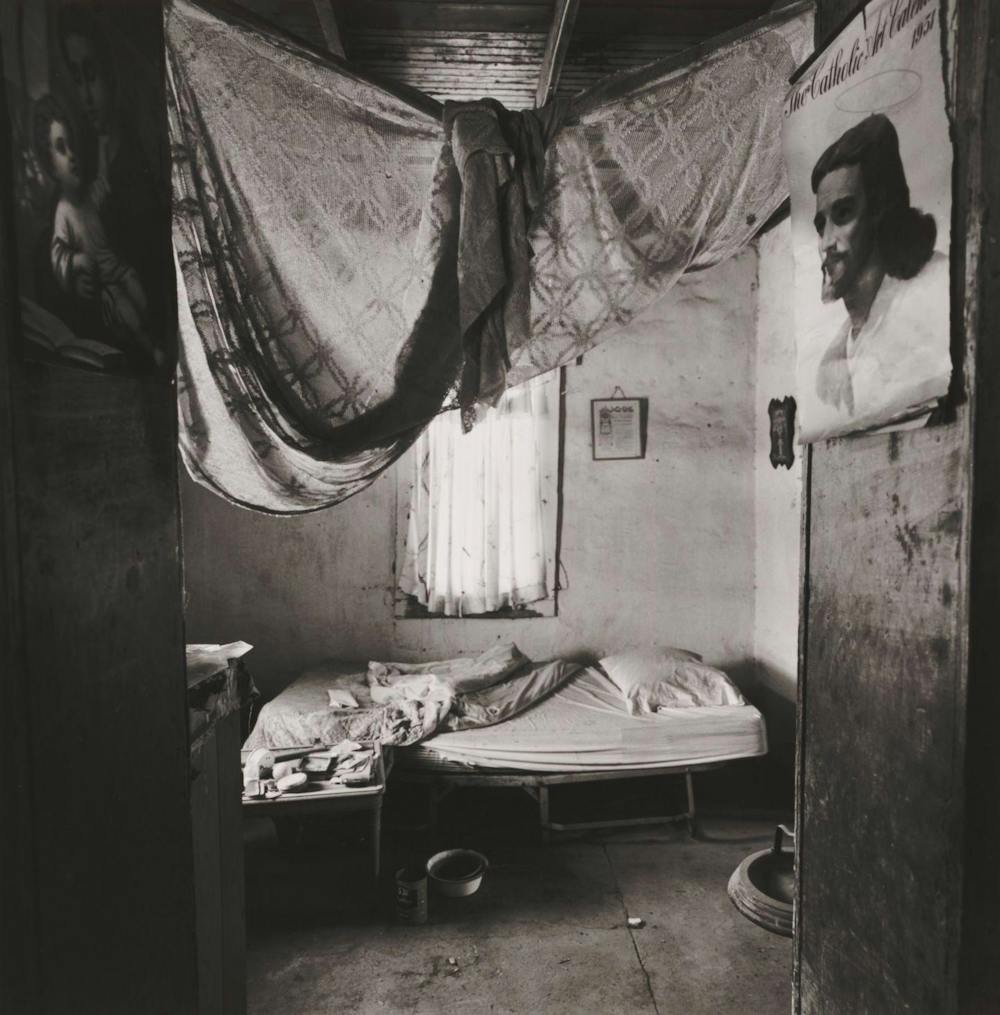
Photo Credit: Center for Creative Photography, University of Arizona
TEMPE, Ariz. – Ahead of this year’s Hispanic Heritage Month, Arizona State University professor Anita Huizar-Hernández shared how photographer Louis Carlos Bernal’s “Benitez Suite” continues to influence and preserve Chicano art, culture and the history of Borderland communities, said Sept. 9 at the Tempe History Museum.
Anita Huizar-Hernández gave a lecture to the public about the “Benitez Suite," a collection of six black and white photographs taken inside the abandoned home of Mary Benitez in 1977. These photographs helped to capture a different perspective on Chicano life during that time, Huizar-Hernández said. Bernal was able to photograph both the private and public spaces that reflected their lifestyles.
“These images blur the boundaries between the past and the present, presence and absence, loss and endurance and in doing so I want to propose that they center Borderlands life against the forces that have constantly tried to erase it.”
In an interview before his death in 1993, Bernal defined his understanding of “Chacanismo,” saying, "Mexican-American is the term used to describe a person who is of American birth but whose cultural soul derives from Mexico.”
During a time period with weighing conflicts and injustices, it was significant for Bernal to establish a clear meaning when describing that group of people, Huizar-Hernández said.
“Chicanismo allows us to accept our history but also gives us a new reality to deal with the present and the future,” Bernal said. “To be a Chicano means to be involved in controlling your life. Chicanismo represents a new sense of pride, a new attitude and a new awareness.”
Bernal used his art as a way to preserve Chicano lifestyles in many different settings which has contributed to connecting more people with the community and its history.
His photographs of the abandoned home still held the essence of belonging, which highlighted his ability to identify what creates a warm atmosphere.
Bernal captured the essence of Chicano culture and people through his photography. According to Huizar-Hernández, he later became known as “the father of Chicano fine art photography,” while having been heavily influenced by Chicano documentary photography. This preserved what these individuals were facing, including protests and a desire for social justice.
His ability to find purpose and meaning in fine art photography was different from other photographers at the time who focused on traditional artistic subjects rather than documenting everyday lives. His ability to capture the real authentic conditions and experiences created a distinction between other photographers, Huizar-Hernández said.
Bernal was able to document different aspects of life and in doing so share that history and culture with so many people, Huizar-Hernández said.
Bernal’s photography reflects the significance of Hispanic Heritage Month by preserving the cultures, identities, traditions and everyday experiences of Mexican American communities.
Vic Linoff, a member of the Tempe History Society, said, “You can really appreciate not only the artisanship, but the technical ability of the photographer.”
Photography was a more extensive process before digital cameras, which shows the skills Bernal carried to create such art, Linoff said.
“Black and white tells a clearer story because you're focused on the images that are in that photograph, as opposed to the distractions that color might have…I think that’s just an important aspect of Bernald's work,” Linoff said.
The use of black and white photography highlighted important details. Linoff said there is an unspoken contrast between the good and evil, the domestic and the spiritual, and so much more.
“He influenced a lot of photography with the way he staged his photos,” said ASU student Abigail Yoon.
Bernal continued to encourage and influence photography to better preserve different cultures using a variety of lenses and perspectives.