
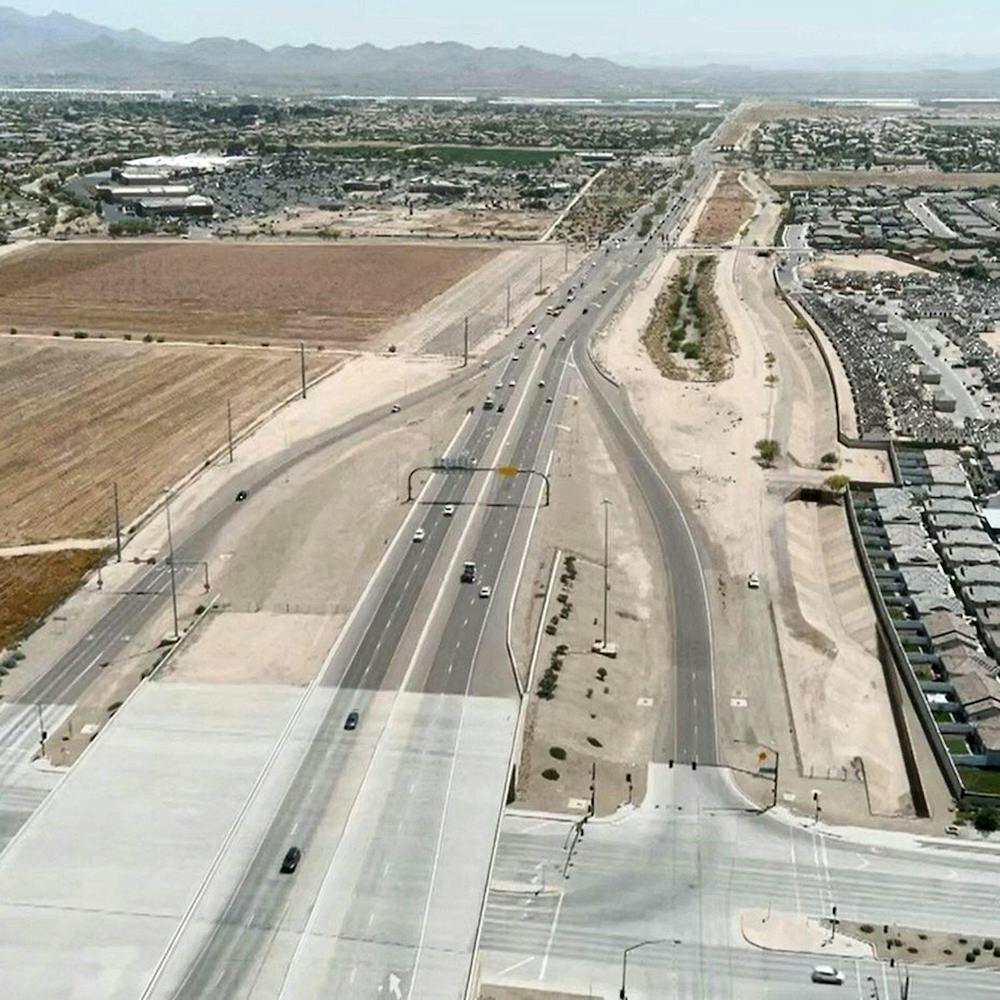
Photo Credit: Business Journal
PHOENIX - Rich Johnson, an associate professor at the Walter Cronkite School of Journalism and Mass Communication, said his daily commute from the City of Maricopa is a nightmare.
Johnson, like many Maricopa residents, relies on Arizona State Route 347, the only highway that directly connects the city of Maricopa to Phoenix.
Over time, the city of Maricopa’s population has grown rapidly to about 80,000 people.
“And the infrastructure wasn’t built enough to handle that many people,” Johnson said.
He describes traffic on Route 347 as being constant bumper-to-bumper traffic during high-volume times.
“It basically turns my commute from 50 minutes in no traffic to about an hour and 30 minutes in peak traffic,” Johnson said.
Maricopa Association of Governments Principal Freeway Engineer Kristin Hutson leads a feasibility study completed on the Loop 303 and 96th Avenue Interchange.
The Maricopa Association of Governments Transportation Policy Committee approved the Loop 303 at 96th Avenue Traffic Interchange Feasibility Study on Sept. 16.
Hutson said that the Loop 303 feasibility study focused on the recent and rapid growth of the Northwest region of Peoria.
“The Northwest region has seen a lot of growth, and MAG has done several studies in response to that growth,” she said.
Hutson discussed how the new developments are involved with the Loop 303 Interchange and the Peoria Innovation Corps.
“The city of Peoria and Arizona State Land (Department) have a partnership where Peoria can develop this land, which they are doing,” she said.
At the moment, only one interchange is located at Lake Pleasant Parkway, but a second interchange within the PIC at 96th Avenue is under construction.
Another project, Amkor Technology Inc.’s 170-acre site, located west of 96th Avenue, is currently under construction.
“And it will be operational by 2028, so this is going to impact traffic in the area,” Hutson said.
She noted that the second and newest interchange will be located southwest of the Amkor facility.
Hutson showed different options for solutions to the traffic problems per the Maricopa Association of Governments’ provided criteria.
The provided solutions to the traffic problems were an alternative diamond traffic interchange or an alternative single-point urban interchange.
Hutson presented and explained the specific details of one design, the alternative diamond traffic interchange at the Sept. 16 meeting.
“You’ll have three lanes in each direction on 96th Avenue,” Hutson said. “One northbound right turn lane and two southbound right turn lanes. Two signalized intersections, dual left turn lanes, lanes on the ramps.”
When comparing the different solutions, two areas stuck out to Hutson and her team: the bridge structure and maintenance.
Both seemed to have a higher impact but lower overall benefits.
After multiple meetings with stakeholders, the preferred and final alternative considered was the diamond traffic interchange design.
Debbie Lesko, a representative for Maricopa County on MAG’s Regional Council, sought some clarification about Peoria’s involvement in the study.
“This is a high priority for them,” Lesko said. “They gave up an interchange at a different location in order to free up funds for this one.”
The Loop 303 at 96th Avenue Traffic Interchange Feasibility Study is on schedule after its final approval last month.
The next steps include Arizona’s Department of Transportation taking the project to final designs and development this fall.