
(Photo/AZ Central)
When senior wide receiver Reed Harris left his days of shooting gophers in Great Falls, Montana, behind to pursue Power Four college football, he still wanted to represent Big Sky Country to the fullest.
Through Arizona State’s first three games of 2026, Harris did just that.
His 374 yards receiving and five touchdowns were the most by a Sun Devil receiver since Derek Hagan in 2004 and ranked 16th among all FBS wide receivers despite a bye week.
Harris had also formed a close on-field relationship with junior quarterback Cutter Boley, connecting with him nine times for over 20 yards – the most in the Big 12.
Entering play on Saturday night, Harris and Boley looked poised to continue that connection against a formidable Baylor defense that hadn’t allowed a 20-point game.
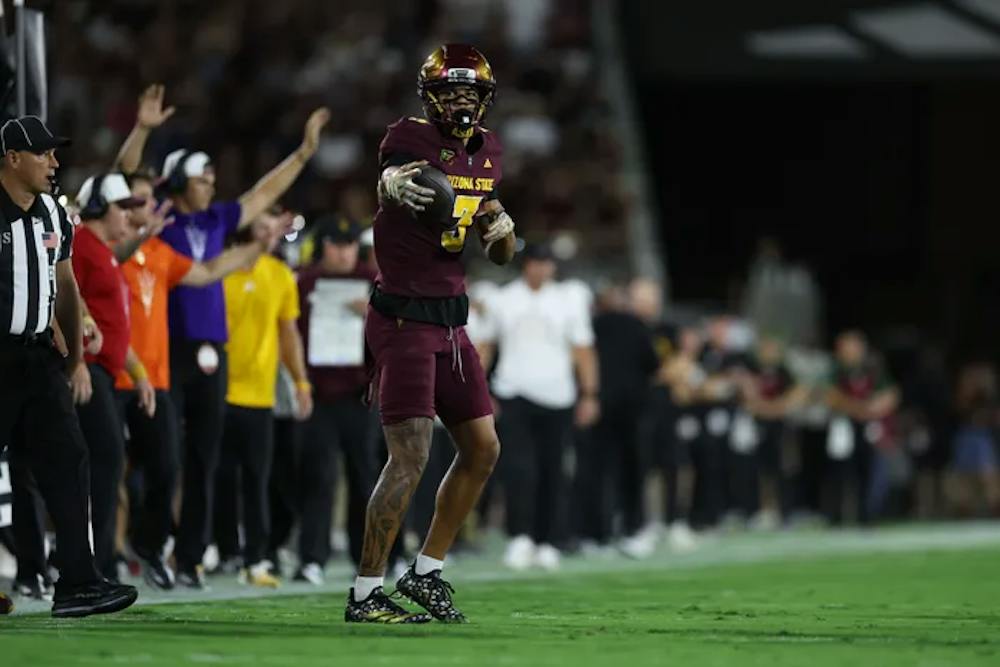
Early in the first quarter, Boley found his No. 1 target downfield and open inside the 10-yard line. Yet with a likely walk-in touchdown in sight, Harris dropped the pass.
Despite Harris ultimately catching seven passes for 125 yards, that missed opportunity only previewed what was to come, as the Bears (4-1, 2-0 Big 12) held the Sun Devils (2-2, 1-1 Big 12) to under 20 points and a pedestrian 45 first-half rushing yards. As a whole, ASU’s offense averaged under six yards per play and was outscored 31-6 in the second half, leading to a 55-19 rout on Saturday, Oct. 3, at Mountain America Stadium.
Head coach Kenny Dillingham called the performance unacceptable, but he knew the challenge of facing a Baylor defense that had held opponents to an average of 13 points per game.
“They did a great job. They were trying to limit the explosive … they stopped us in the red zone, and then they got us off rhythm," Dillingham said. “They created a pass rush. They were one of the best teams in the country in TFL (tackles for loss) rate and sack rate, and that showed up.
“The things that they did really well, they continued to do really well.”
All night long, the Bears’ defense pressured a makeshift ASU offensive line that was already without junior right guard Wade Helton, who is expected to miss a few weeks after injuring his leg against Texas A&M.
Baylor’s defensive front sacked Boley three times and forced an ill-advised back-foot throw that was intercepted.
“I was sloppy with the ball … I made a few poor decisions that really put us behind the eight ball,” Boley said. “Things like that can’t happen.”
Facing a defense that was constantly applying pressure up front, ASU’s ground attack was rendered nonexistent, with no rusher posting more than 34 yards.
“The things that they did really well, they continued to do really well,” Dillingham said.
After rushing for 133 yards in its Week 3 victory over Kansas, ASU averaged just 3.3 yards per carry and under 100 yards rushing on Saturday.
In perspective, a 75-yard touchdown run by Baylor sophomore running back Caden Knighten in the third quarter matched ASU's total rushing yards at that point.
Dillingham said they must play better complementary football on offense, and that starts with improving the run game.
“We got to run the ball better,” Dillingham said. “You can’t run the ball 30 times for 99 yards. That’s not going to be productive. There’s not enough balance there.”
The Sun Devils’ longest rush of the night came on an 18-yard run by freshman running back Cardae Mack, who later posted 16 yards on four subsequent attempts. Baylor had two rushes for over 60 yards and averaged 6.8 yards per carry on Saturday night.
The trio of Mack and seniors Kyson Brown and Marquis Gills combined for fewer yards rushing (90) than Baylor had in the first quarter (114).
Dillingham pointed to various tackles for losses as the reason the rushing attack couldn’t find momentum.
“I thought we got movement in some of the inside zone game at times, and then there were some critical TFLs … which can knock you off rhythm in drives,” Dillingham said. “And that’s how they play defense.”
While the ground game left much to be desired, ASU’s passing attack did create some opportunities.
Boley passed for 304 yards, including five passes for over 15 yards, and found senior wide receiver Omarion Miller in the end zone for a late touchdown.
Despite the early drop, Harris and Boley did connect for 125 yards and a 41-yard pass. Yet whenever the offense took a step forward, Dillingham said it took two steps back.
“Whenever we got some positive, then we hit a TFL,” Dillingham said. “It was like ‘Golly, we can’t continue to get TFLs on early safe downs.’”
Unable to gain positive yardage on early downs, ASU faced 15 third downs and converted just four (27%) down from a Big 12-worst 30% entering Saturday.
Though Boley consistently faced a long field and was unable to generate any momentum on offense, Dillingham expressed confidence in him, shooting down any questions about a quarterback controversy.
I’ve been happy with how Cutter’s (Boley) has played,” Dillingham said. “I know that’s not going to fire people up because when you don’t play well, it’s like, ‘Oh, whose head, right? We’ve got to make such drastic changes,’ and I just don’t believe in that.”
Dillingham said they’ll know if that predicament arises.
“If there ever was a situation where I thought we had to make a change somewhere, we are always going to be able to make a change at any position that makes us better,” Dillingham said. “But do I think that is even close to the realm of possibility right now? Absolutely not.”
Sports Managing Editor, Blaze Radio