
Photo Credit: The New York Times
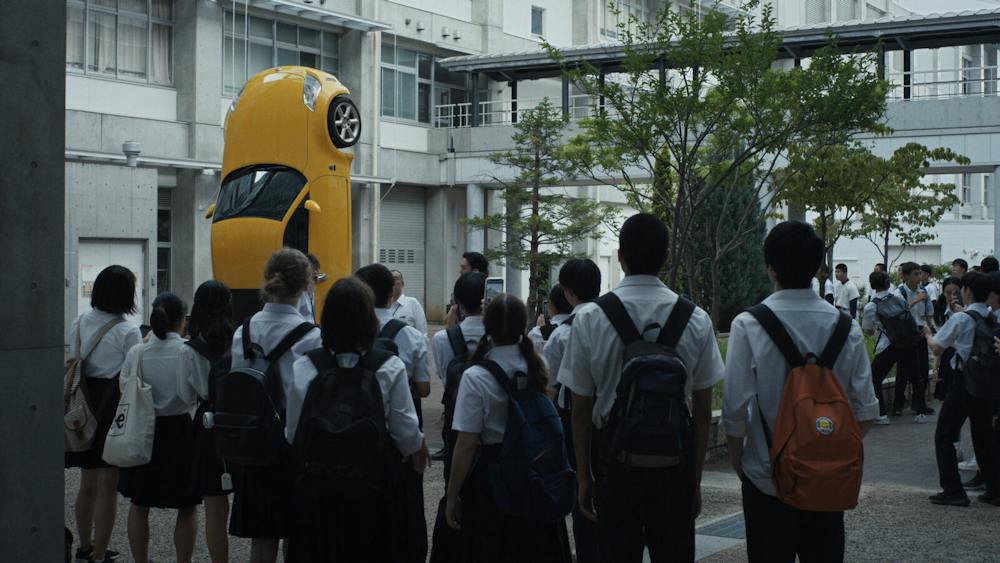
“Happyend,” a 2024 dramatic dystopian narrative, is Neo Sora's first feature film as a director. It follows two high school seniors, Yuta and Kou, in Japan as they navigate the consequences of pranking their principal by tipping his car onto its rear bumper.
The film's uniqueness hits you right out of the gate as it is set against the backdrop of electronic dance music. Some people believe EDM is a genre you'd only find in the United States or Europe, but it's been in Japan since 1978.
European-style EDM — which blends elements of disco and other dance styles — made its way to places like Tokyo in the 1980s and 90s, allowing Japanese artists in the years since to blend European-style EDM and synth-pop with Japanese sensibilities, turning it into a social phenomenon.
The EDM is paired beautifully with the struggles and political oppression that Japanese people are facing, and it's not too dissimilar to what we are seeing here in America.
One of the film's biggest issues is that, because of the prank, the school installs a high-security facial recognition system.
This acts as a direct cause of creating a culture where xenophobia and surveillance are being used daily. This is shown because Kou is Zainichi Korean; his family is Korean and moved to Japan sometime between 1910 and 1945, when Korea was under Japanese colonial rule. Because of this, whether by school administrators or the police, Kou is looked down upon for not being like everyone else.
This kind of oppression is very similar to what we saw during the Civil Rights Movement and, unfortunately, still see today.
Poignantly, the film shows that fighting for causes you believe in can drive real, positive change, no matter the country or obstacles involved.
It also reminds us that when conflicts arise, you can't turn a blind eye to them or let them slip by the wayside. You have to take them head-on. A small group of students forced the principal into a sit-in to discuss removing the facial recognition cameras, which is a subtly wonderful approach to see.
Concerns we can't turn away from have even shown up recently here in America. On Sept. 8, Jacob Coxon, a former pre-training researcher at Anthropic, posted on X that if safeguards aren't put in place to combat the growing world of AI, humanity could end in the next decade. Evan Hubinger, Anthropic's alignment science lead, followed up on Coxon’s post, saying that he personally believes there is a greater than 10% chance our extinction could occur as early as 2030.
We even see a Japanese society portrayed where, due to the emergency decrees that get released after a major earthquake in the film, the Japanese are living under a bureaucratic authoritarian rule, and they don't have as many rights to speak out for fear of harmful retribution.
This is quite similar here in the United States because, over the years, American democracy has undergone a similar democratic backsliding. Sora captures the agonizing reality of living in a slowly boiling pot, where the tightening grip of surveillance and bureaucratic retribution doesn't arrive with a loud explosion, but rather through a quiet, steady erosion of free speech that hits terrifyingly close to home.
Young people, whether it's here in the United States or in Japan, are the next generation of people who are going to create an equitable society for all, and if we silence them, it makes our world a place that continually has division instead of us coming together, where no matter if we have the same views on certain issues, we can build a society where we celebrate diversity and the power of unity.
While the film was slow in parts and could have used more EDM, I was blown away by how, unfortunately, the stark realities being put on full display throughout the film are not unlike the American society we are living in, and therefore, on JFoo’s Footastic rating scale, I give “Happyend” four stars out of five.