
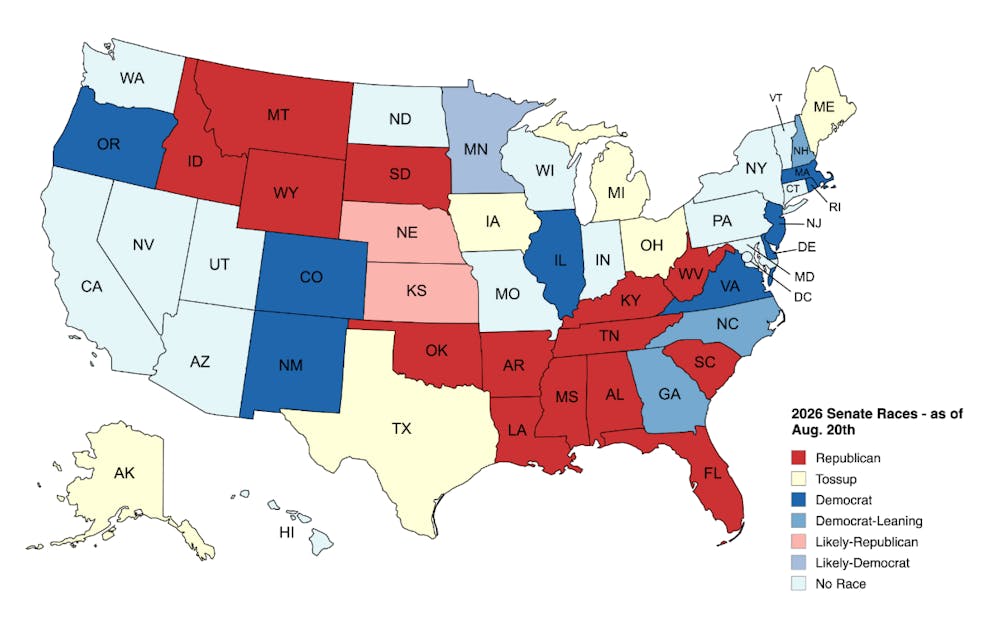
Photo Credit: The Cook Political Report
Thirty-five Senate seats are up for election this November. Currently, the Senate is divided by 53 Republicans and 47 Democrats. These races are crucial because if the Democrats gain four more seats, they retake control of the Senate. They’re also important as their outcomes will affect the partisan balance of the Senate, which has been controlled by Republicans since Jan. 3, 2025. Of the 43 states holding elections, 10 are especially competitive: Alaska, Georgia, Iowa, Maine, Michigan, Nebraska, New Hampshire, North Carolina, Ohio and Texas.
The polling percentages represent the voters' most recent support for each candidate as shown in The New York Times.
Seats Republicans Are Defending
Alaska
Lisa Murkowski and Dan Sullivan, both Republicans, are the current Senators. Alaska practices an all-party, ranked-choice voting system. This system has led to two candidates with the same name competing against each other, Dan S. Sullivan and Dan J. Sullivan. Incumbent Dan S. Sullivan is running for his third term against Democrat Mary Peltola, who won the House seat in 2022. The GOP worries that Republican newcomer Dan J. Sullivan will confuse voters, which would help Peltola win. Peltola is currently leading the close race between her and Sen. Sullivan 51% to Sullivan’s 49%.
Iowa
On Sept. 2, 2025 Republican Sen. Joni Ernst announced she will not seek reelection following statements she made in May 2025. Ernst faced controversy after telling a constituent concerned about deaths linked to Medicaid cuts in the One Big Beautiful Bill Act, “Well, we all are going to die,” during a town hall in Iowa. She later received more criticism after posting a sarcastic apology video filmed in a cemetery. This left the seat open for the first time since she won it in 2014. Republican Ashley Hinson, a U.S. representative endorsed by President Donald Trump, is facing Democrat Josh Turek, a state representative from Council Bluffs. Democrats have not won a senate election in Iowa since 2008, but Democrats are seeking the chance to flip the seat, making it another race that could help determine control of the Senate. Currently Hinson leads Turek 50% to 48%.
Maine
Republican Sen. Susan Collins is running for reelection against Democrat Troy Jackson, a former longtime state legislator. Even though Collins has won the Democratic-leaning state since 1997, recent polling shows that Maine residents want a change. Recently Collins has drawn growing criticism for her support of Trump’s policies, her vote to confirm Justice Brett Kavanaugh, a justice in the majority of Roe v. Wade being overturned and her lack of accountability over I.C.E. operations. Jackson takes an 8% lead. The race gained attention after the original Democratic nominee, Graham Platner, withdrew following sexual assault allegations. Jackson was then selected as the replacement. If Jackson wins, Democrats would gain a Republican-held Senate seat; if Collins wins, Republicans would retain an important seat in their effort to control the Senate. Currently Jackson leads Collins 50% to 42%.
Nebraska
Deb Fischer and Pete Ricketts, both Republicans, are Nebraska’s Senators as of right now. Ricketts was appointed Senator in 2023 and is the incumbent running for reelection. Mike Marvin, from the Legal Marijuana Now Party, and Dan Osborn, Nonpartisan, are also on the ballot. Cindy Burbank, who won the Democratic primary, chose to withdraw from the general election. “I’ve looked at the numbers. I won’t be your next senator. So I have withdrawn my bid for U.S. Senate,” she said. This has cleared a path for Osborn who ran as an independent candidate for the U.S. Senate in 2024. Ricketts and Osborn are evenly matched in this race at 47% for the moment.
North Carolina
The Republicans control the Senate in the Tar Heel State with Senators Thom Tillis and Ted Budd. Additionally, it’s one of 11 open Senate races where an incumbent isn’t running for reelection after Sen. Tillis decided against running for reelection. The candidates competing in the U.S. Senate election for North Carolina are Roy Cooper, Democrat; Michael Whatley, Republican; Michael Dublin, Green; Shannon Bray, Libertarian; and Shaunesi Deberry, Independent. Cooper was Governor from 2017 to 2025. Whatley was chairman of the North Carolina Republican Party from 2019 to 2024. Democrats in this state haven’t won a U.S. Senate seat since 2008, but have won the governorship every year except 2012 in this same period. Currently, Cooper is leading the race 50% to Whatley’s 45%.
Ohio
Bernie Moreno and Jon Husted, both Republicans, have seats in the Senate for the moment. Incumbent Husted, former Democratic Sen. Sherrod Brown, Libertarian Bill Redpath and Independent Gregory Levy are competing in the U.S. Senate election for Ohio. The winner will serve the two remaining years of the term that Vice President J.D. Vance had been elected for in 2022. Republican Gov. Mike DeWine had appointed Husted to replace Vance in the Senate on Jan. 21, 2025. Brown, a former Senator, previously lost a reelection in 2024. As of right now, Brown leads the race 46% compared to Husted’s 41%.
Texas
Republican Attorney General Ken Paxton defeated longtime Sen. John Cornyn in the Republican primary runoff on May 26, 2026, while Democrat James Talarico won the Democratic nomination; Talarico has served in the Texas House of Representatives since 2018. The 2026 Texas U.S. Senate election is on pace to be not only one of the most competitive elections this year, but one of the most expensive Senate races in U.S. history. In June, ad-tracking service AdImpact predicted that $446 million would be spent on media to elect Paxton or Talarico, according to WZTV Nashville. The battleground state has two Republican senators representing it nationally, though recent polls give Talarico a 6% lead. If Talarico wins, he will be the first Democratic senator to represent Texas since 1993. Currently Talarico leads Paxton 48% to 42%.
Seats Democrats are Defending
Georgia
Democratic Sen. Jon Ossoff is running for reelection against Republican Rep. Mike Collins. In 2024, Georgia voted for Trump, and the president endorsed Collins saying, “Mike Collins is a true friend, fighter, and warrior.” The young senator will have plenty to fight for and prove as he tries to retain his Senate seat. Over the last several elections Georgia has shown it is a swing state, so even though Ossoff currently has a 7% lead in recent polling, it could go any way. Currently Ossoff, the youngest sitting senator, leads Collins 50% to 43%. Ossoff still has a long way to go.
Michigan
Democratic Sen. Gary Peters will not seek reelection leaving the seat open. The two major-party candidates are Progressive Democrat Abdul El-Sayed. El-Sayed was a former executive director of the Detroit Health Department. Republican Mike Rogers, a former congressman, lost a close Michigan Senate race in 2024. El-Sayed won the Democratic primary against Rep. Haley Stevens. Current polling shows this will be a close race, with a recent poll conducted in the last week of August giving El-Sayed a 4% lead. The election is especially important as Michigan is a swing state: this race could determine which party controls the Senate. Currently El-Sayed leads Rogers 47% to 43%.
New Hampshire
Maggie Hassan and Jeanne Shaheen, both Democrats, are the current Senators. The primary elections have yet to take place and will happen on Sept. 8, 2026. Edmond Laplante, Constitution Party; Matt Giovonizzi, Independent; and Tim Harris, Independent, are the candidates competing in the general election so far. This is another Senate race in which an incumbent is not running for reelection. The Democratic primary candidates are David Jarvis, Karishma Manzur, Chris Pappas, Maxwell Saal and John Vail. The Republican primary candidates are Tom Alciere, Scott Brown, Sky Danley, Andy Martin, Mary Maxwell, Richard McMenamon II, Sabrina Smith and John Sununu. For the Democratic primary, Pappas currently takes the lead 71% compared to Manzur’s 15%. For the Republican primary, Sununu currently takes the lead 60% compared to Brown’s 20%.
Credits: The New York Times, The Washington Post, Ballotpedia, NBC News, PBS, The Cook Political Report, WZTV Nashville, Maine Democrats, NPR, KGAN Iowa